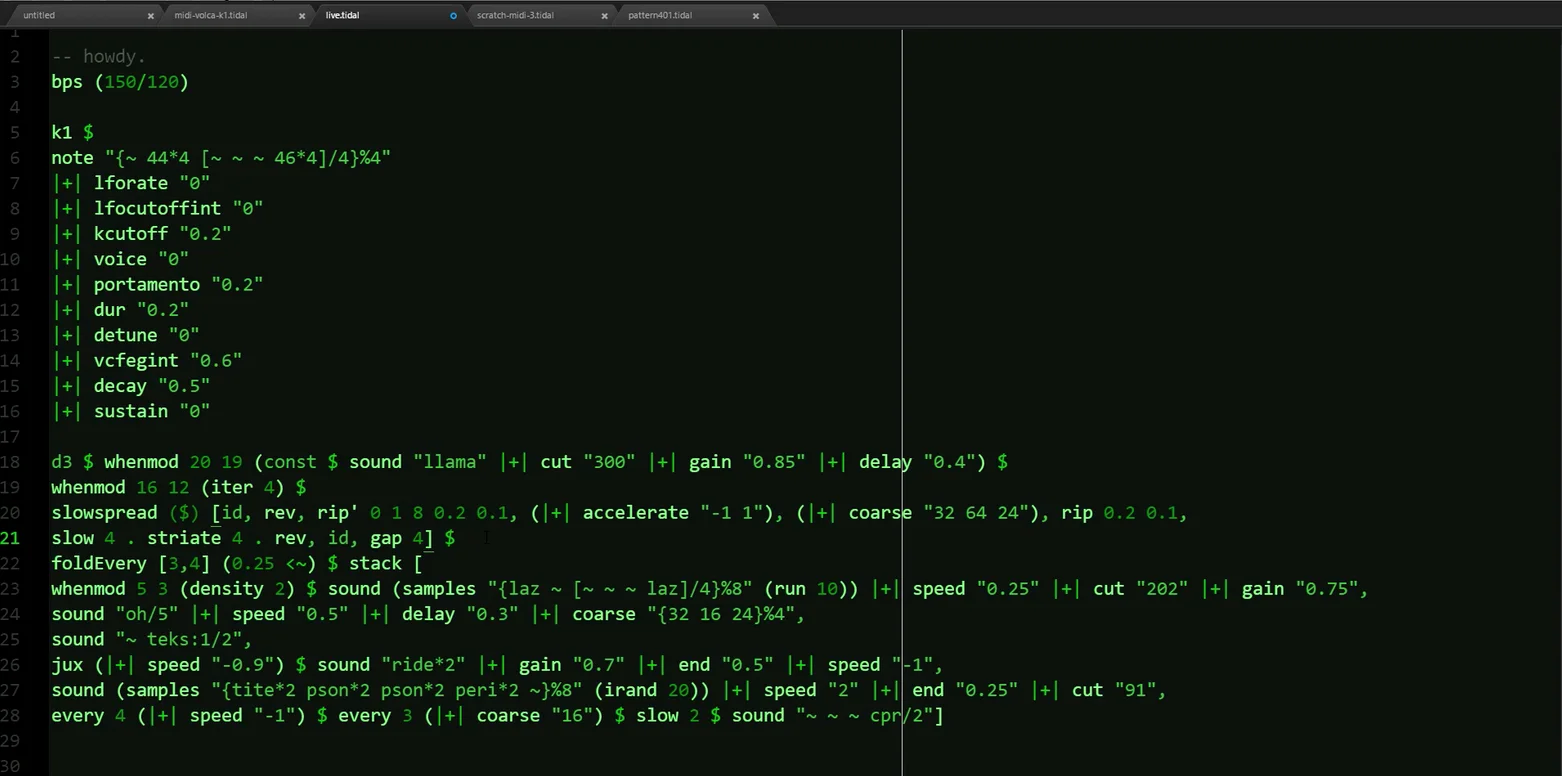
Tidal Cycles
A live coding instrument by Alex McLean where patterns become music, Haskell enters the club and changing the code mid-performance is not a bug but very much the point.
Programming - Live Code
Product information
Overview
TidalCycles turns patterns into a musical instrument. Instead of placing notes on a timeline, you describe rhythms, melodies and transformations with compact expressions, evaluate the code and hear the result immediately. Created by Alex McLean from ideas he began exploring around 2006, Tidal grew from research into rhythmic structure into one of the defining tools of live coding and algorave. Somewhere along the way, writing Haskell at a rave became a perfectly reasonable thing to do.
Pattern Everything
Tidal is less about telling a sequencer exactly what every note should do and more about describing how musical events behave over time. Simple patterns can be stretched, layered, shifted, randomized and transformed into structures that would become deeply unpleasant to draw by hand. And patterns are not limited to notes. Parameters, effects, MIDI and other information can all join the party. Change an expression while the music runs and the pattern changes with it. The code is not preparation for the performance. The code is the performance.
The Tidal Lasagna
Tidal is not one giant application, and even its own documentation describes the setup as the Tidal Lasagna. Your editor talks to Tidal, Tidal lives in Haskell, SuperDirt handles the synthesis and sampling layer, and SuperCollider ultimately makes the speakers do something useful. It sounds like a lot of moving parts because it is. Once everything is talking, however, the result is a remarkably expressive instrument. Until then, congratulations, your first live coding performance may involve debugging audio routing.
Hacking in Nightclubs
Long before Tidal became associated with algoraves, Alex McLean was already performing live coded music with Slub and a homemade Perl system called feedback.pl. He even wrote about the practice in 2004 under the wonderfully direct title Hacking Perl in Nightclubs. Tidal continued that philosophy with a much deeper focus on patterns. Today it is used for composition, improvisation and performances where audiences can watch musicians rewrite the systems producing the music in real time. Apparently laptops can be instruments after all.
Technical specifications
- Software type
- Standalone
Minimum
No specific requirements provided.