Jack Audio Connection kit
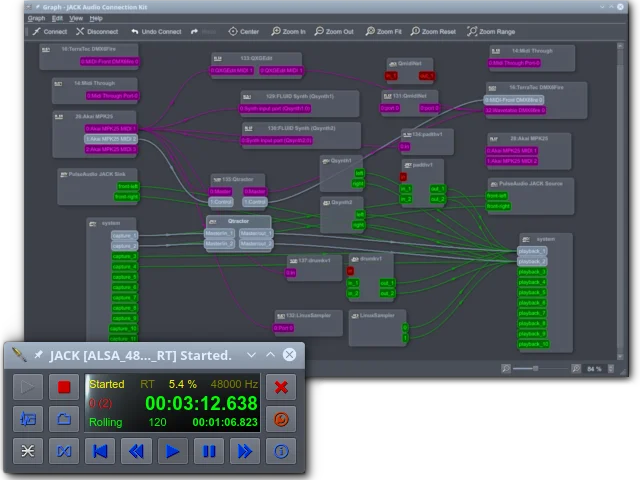
JACK connects audio and MIDI applications like virtual patch cables. Simple idea, extremely serious routing possibilities and enough ports to make your computer look like a modular synth.
Audio & Midi Utilities - Sound Server
Product information
Overview
JACK is the plumbing behind some wonderfully complicated audio setups. Instead of letting every application guard its audio like private property, it gives software and hardware a shared low-latency environment where signals can be routed wherever they need to go. Created by Paul Davis around 2000, JACK became a cornerstone of professional audio on Linux and found its way onto other platforms too. You may not make music in JACK, but there is a decent chance JACK is busy underneath making sure everything else can talk.
Connect All the Things
JACK treats applications as collections of inputs and outputs that can be connected almost like virtual cables. Send a synthesizer into an effect, route that into a recorder, split it somewhere else and change the whole setup while it is running. That simple idea can produce hilariously elaborate signal graphs, but it also removes many artificial boundaries between applications. If two JACK clients expose compatible ports, JACK is basically standing there holding a cable and waiting for you to make questionable routing decisions.
Built for Real Time
JACK was designed for situations where audio arriving eventually is not good enough. Its focus on low latency, synchronization and predictable real-time processing made it especially valuable for recording, software instruments, live performance and professional Linux audio workflows. Getting an ambitious JACK setup perfectly tuned can occasionally feel like earning a minor degree in computer audio. Once it behaves, though, an entire collection of independent applications can start feeling like pieces of one enormous modular studio.
Not Just Linux Plumbing
JACK became closely associated with Linux audio, but the project is cross-platform and its influence reaches beyond its own ecosystem. Its flexible connection model helped demonstrate how independent audio applications could cooperate without pretending they were all part of the same giant program. That philosophy is probably JACK's real superpower. Keep tools separate, connect what you need and let users design the studio. Unix philosophy, except somebody added patch cables.
Technical specifications
- Software type
- Standalone
- Sample rates
- 44.1 kHz | 48 kHz
Minimum
- Notes
- For Windows 7 or higher. 64-bit builds provide mixed 32/64-bit support.